Teatr Wielki Opera Narodowa
Articles
Polish National Ballet

„CriticalDance”:


Krzysztof Pastor appointed director of the Polish National Ballet 


   Krzysztof Pastor, resident choreographer of the Dutch National Ballet in Amsterdam, was appointed the new director of the Polish National Opera ballet company in Warsaw on 15 March 2009. Born in Poland, he was educated in Gdańsk, and began his career as a dancer in 1975 when he joined the Polish Dance Theatre in Poznań. Starting in 1983, he danced as soloist with Le Ballet de l’Opéra of Lyon, and from 1985 to 1995 with the Dutch National Ballet. He debuted as a choreographer in Amsterdam in 1987, and in 2003 was appointed resident choreographer of the Dutch National Ballet. He has also worked as a choreographer with the Washington Ballet, Royal Swedish Ballet, Scottish Ballet, Israel Ballet, Australian Ballet and West Australian Ballet, Royal New Zealand Ballet, Lithuanian National Ballet, Latvian National Ballet, Semper Oper Dresden, Royal Flemish Ballet, and Donau Ballet, and also for Svetlana Zakharova and Andrei Mercurev at the Moscow Bolshoi Ballet.

   Waldemar Dąbrowski, former Polish minister of culture and the new general director of the Grand Theatre in Warsaw which is the home of the Polish National Opera, tempted Pastor into leaving Amsterdam and returning to Warsaw by offering him the possibility of turning the opera’s ballet company into the autonomous Polish National Ballet. The company will continue to work at the Grand Theatre, taking advantage of its budget, stages and technical workshops, but now on an equal footing with the Polish National Opera. The company will also present its productions at other theatres around Poland. Pastor’s partner for programme and organizational matters is Polish ballet critic Paweł Chynowski, and the company’s ballet mistress will be Warsaw teacher Kalina Schubert. The previous director of the Warsaw ballet company, Emil Wesołowski, will stay on as resident choreographer.

   This season in Warsaw, Krzysztof Pastor is producing his full-length ballet “Tristan” to the music of Wagner (premiere on 29 March 2009), and after the holidays, on 20 November 2009, he will stage another of his ballet productions, “Kurt Weill”, which was greatly successful in 2001 in Amsterdam and was nominated for the prestigious Benois de la Danse prize. April 2010 will see the ballet company working with French choreographer Patrice Bart, who has been commissioned to produce a new ballet about Frédéric Chopin to mark the 200th anniversary of the great Polish composer’s birth. For June 2010, Pastor has planned a ballet evening entitled Bach Dances featuring pieces by guest choreographers. The company’s repertoire will continue to include earlier great productions staged in Warsaw by Natalia Makarova (“La Bayadère”), Yuri Grigorovich (“The Sleeping Beauty”), John Cranko (“Onegin”), Irek Mukhamedov (“Swan Lake”), Andrzej Glegolski (“The Nutcracker”), Alexei Ratmansky (“Anna Karenina”), and Emil Wesołowski (“Romeo and Juliet”). Workshops for young Polish choreographers will be held every year. Pastor also plans to develop his ballet company’s strength, and to this aim has scheduled auditions for this June to find new soloists and dancers.


[“CriticalDance”, 11 April 2009]  


The playbill of „Tristan” at the Teatr Wielki – Polish National Opera:


Krzysztof Pastor - New leader of the Polish National Ballet


   Poland situated in the middle of Europe and buffeted by Empire builders on all sides, has had its share of history. But it has never lost its strong sense of cultural identity bonded by literature, painting, theatre, music and dance. The Mazurka, bred in the soil and elevated to the salon, has invigorated the ballet for centuries. Similarly to the Polonaise, solemn Polish court dance.  Poland’s first classical ballet troupe, His Majesty’s Dancers was formed in 1785, but Polish dancers have more often than not achieved fame outside of their country. Warsaw-born, Marie Rambert, created one of the world’s most remarkable and enduring dance companies while the names of Vaslav Nijinsky, Stanislas Idzikowsky and Leon Woizikovsky, dancers with Diaghilev’s Ballet Russes, are synonymous with technical brilliance. But this may be about to chance as Krzysztof Pastor, returns to his native land to take over the directorship of the Ballet of the National Opera in Warsaw.

   Krzysztof Pastor came to prominence as a choreographer with the Dutch National Ballet and his works are now in the repertoire of major companies throughout the world. He has written almost fifty works to date including a number of one-act ballets notably “In Light and Shadow,” “Si depues de morir” and “Crossing Paths”, but it is in his full length works that he has earned his stripes. Good choreographers are a rare breed. It is even rarer to find one with the courage and vision to create large-scale works that use an entire ballet company and fill the opera house. Pastor’s major work, “Kurt Weill”, written for Dutch National in 2001, brought him to prominence. The ballet was nominated in three categories for the prestigious International Benois de la Danse prize. In this ballet he demonstrated his skill in handling and juxtaposing choreographic and scenic elements. The dance and the musical landscape were vast, from Berlin bar to Broadway. It was a mammoth undertaking for a young choreographer.

   “Tristan” is similarly a major epic. Premiered in 2005 for the Royal Swedish Ballet, Pastor now reproduces it at the request of the Polish company. Richard Wagner’s music for the opera is some of his most beautiful but Pastor felt it was as much the story that drew him to the subject. “I was absolutely fascinated by the story, it is so strange, even a little naïve – and this incredible love. I also discovered that Wagner had fallen in love with Mathilde Wesendonk, the wife of his patron at the time he was writing about the forbidden love of Tristan and Isolde. It was all so connected!”

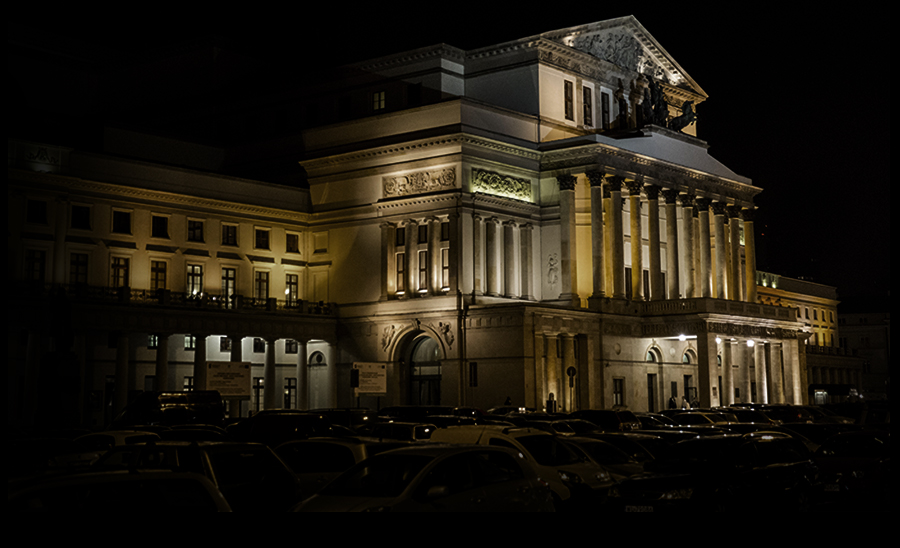
   Pastor sees the chance to rework the ballet in Warsaw as a great opportunity. “At the premiere you see things you want to change but there is no time”. Working with Dutch dramaturg, Carel Alphenaar, they had researched the origins of the legend and adapted it to suit the ballet. The action crosses seas and forests and encounters dragons and angels. Fortunately, the size of the Wielki Theatre in Warsaw, boasting one of the largest stages in Europe, offers exceptional possibilities for the staging. Looking ahead to his directorship of the Company, Pastor said that he would also be looking for a more intimate space, holding six or seven hundred people, where he could stage smaller works of a more challenging nature. This is in keeping with his plans to import the idea of choreographic workshops that have worked so well in Amsterdam. These workshops, where dancers from the Dutch National Company have the chance to try out their choreographic ideas, he rates very highly, acknowledging the part they played in honing his talents.

   Pastor had a very traditional ballet training in Gdańsk, his home town, “strictly Vaganova, but a good school”. More unusually, acrobatic training was on the curriculum and he remarked how useful this had been to him later on when he started to choreograph. While his aesthetic is classical, in his search for concepts and style his imagination ranges much wider. His first job was with the Polish Dance Theatre under the directorship of Conrad Drzewiecki. Drzewiecki had worked in the West and his choreography although classically based was influenced by Martha Graham and Jerome Robbins. Pastor sensed the possibilities in the hybridization of dance technique, new forms grafted onto a classical root. It was also around this time that Pastor saw Rudi van Dantzig’s “Monument for a Dead Boy” when the Dutch National was on tour in Poland. “For me it was such a discovery, that he was able to talk about a difficult subject in a language, so appealing and not at all vulgar”.

   However it was when he emigrated to join Le Ballet de l’Opera of Lyon as a soloist that his eyes were opened to the full potential of dance. “It was a culture shock! I just saw so many forms of dance; abstract, political, or completely crazy. It was a huge opening for me”. Then in 1985 Pastor joined the Dutch National. “Holland was the place to be; Kylian and the Nederlands Dans Theatre and Dutch National with three choreographers, Rudi van Dantzig, Hans van Manen, Toer van Schayk; it was a dream”.

   While dancing in the company, Pastor produced his first piece for the choreographic workshops, Games to music by Pink Floyd in 1987. His first commission for the company “Shostakovich-Chamber Symphony” in 1992 was well received and led to further commissions. However he continued to try his hand in the annual workshops which were “part of the life of the company. I think it is very important that a company not only produces ballets but also produces choreographers. It was also important for me that we had to organise this ourselves. We had to have determination and we had to ask our colleagues to work in their free time and to learn how to work with a group.” It was also an opportunity to get advice. He remembered van Dantzig suggesting that he try something on pointe. “I remember thinking it was not natural but on good dancers, pointe work gives something very, very special. Also it is our aesthetic, our language. I think it is important for the Dutch National and it will be important for the Polish National Ballet.”

   In 1995, his “Detail IV” won the prestigious Philip Morris Award at the Helsinki International Ballet competition. At that time Pastor stopped dancing to concentrate on his freelance choreographic career. He spent two years as resident choreographer with Washington Ballet. He found this a good experience but also discovered how different tastes could be on each side of the Atlantic when his ballet, “Stop It!” which had been so successful in Amsterdam was not appreciated in Washington. 2000 was an exceptionally productive year. “Do Not Go Gentle” after the poem by Dylan Thomas to Stravinsky’s music proved a great success. His next work “In Light and Shadow” was equally successful and has been taken into the repertoire of several companies including Scottish Ballet and the Royal Swedish while the central pas de deux is a favourite at international galas.

   “The choreographic idea comes first, or sometimes the music then the material. The steps I work in the studio; me and the dancers. My relationship with the dancers is very, very important. When I was younger, I wanted to be loved but now I realise that sometimes artistic conflict is not all bad. It can be very productive. Rehearsals are always a battle of the egos because dancers are human beings with a lot of characters. At the Dutch National you have to really convince the dancers, to motivate them. This might be the reason why this is such a creative company. I also like working with people who are bright and bring a lot of knowledge as well as the confrontational element which I think is very, very important. There are difficult moments, even irritating, but I know it’s good.”

   Krzysztof Pastor’s style is the product of his varied background. His choreography builds on the ballet vocabulary in a way that is both contemporary and innovative, exploiting to the full the dancers’ potential. His range even extends to the use of almost forgotten steps like the gargouillade, a pas de chat with added frills. These are put to wonderful effect in “Don Giovanni” to express Zerlina’s frison of delight in the Don’s advances. He enjoys narrative works but always looks for a different angle, “it is the emotional impact that is important. When I started to choreograph my first works in Holland, it was like I had come from another planet because I was doing things that were quite emotional and this was at a time when dance was very abstract. Hans van Manen famously said, 'dance is only dance'. But I think things have changed now”. Even in Pastor’s plotless ballets there runs an undercurrent of emotion. “Si después de morir...”, to music by Mauricio Sotelo carries a suggestion of Andalusian passion while the classically structured, “In Light and Shadow”, inspired by Bach conjures a Baroque world. The harsh monochrome of “Crossing Paths” is tense with distilled passion while “Moving Room” is aggressively edgy. Each has a distinct personality creating a sense of occasion.

   His acclaimed “Romeo and Juliet” for Scottish Ballet while updating and sharpening the plot was essentially narrative, “Kurt Weill” was nearer to a documentary style while in “Don Giovanni” he was interested in capturing the allure of the central character. Writing a full-length work is always challenging, but Pastor rates this ballet as his greatest challenge. “The story was so complicated, the score was late, I was terrified most of the time – and it doesn’t get easier. From my first piece I was already worried that in the next piece I would repeat myself so I always try to challenge myself to invent something new. The day you start a new piece it is like walking with your eyes closed. You don’t know where you are going. I remember reading an interview with famous dancer Richard Cragun. He was working with John Cranko on a new ballet and he noticed when he touched the choreographer’s arm that he was trembling! And Cranko was already a famous choreographer!”

   As a child Krzysztof Pastor was sent to ballet school because he had too much energy and at each turn in his career he has chosen the path that is more challenging and interesting rather than the safe option. His dancing career has brought him into contact with an impressive cross-section of major choreographers and the ideas he has chosen for his own choreography are equally diverse. In his choice of music he gravitates to that which speaks to him whether it is as complex as Lutosławski or as comfortable as Mozart. Similarly with his colleagues he accepts the friction that brings something interesting in the end. His willingness to face challenges will stand him in good stead as he starts his new project; to revitalise the company in Warsaw.


Maggie Foyer


[An article written by Maggie Foyer in March 2009 to the programme of „Tristan” premiere by Krzysztof Pastor at the Teatr Wielki – Polish National Opera. Maggie Foyer is a freelance British journalist. She writes about dance and publishes regularly in the magazine Dance Europe.]


"Ballet2000":


News – from the dance world


   53-year-old Polish choreographer KRZYSZTOF PASTOR, has been Het Nationale Ballet’s resident choreographer since 2003 (the ‘other’ resident choreographer being no less than Hans van Manen). In the course of his career, Pastor has worked with a number of companies in Europe, the United States, Oceania and the Middle East, such as Scottish Ballet, the Dresden Ballet, the Royal Ballet of Flanders, Australian Ballet, The Washington Ballet etc. Pastor, who made his début as a choreographer in 1986 in Lodz, Poland (where an important dance festival is held) returned to his native country in Spring 2009 to become director of the POLISH NATIONAL BALLET. This is how the company is now called, but we must not forget that we are talking about the ballet company of the Teatr Wielki (literally the “Grand Theatre”) of Warsaw. In November, the troupe presented a ballet that Pastor had originally created in 2001 for Het Nationale Ballet: “Kurt Weill”, based on the life and work of the eclectic German composer (who worked with Bertolt Brecht). Aside from other ballets by Pastor (such as “Tristan” to music by Richard Wagner, which is going to be revived in January), in the course of this season the company will be offering classics from the 19th century repertoire (“La Bayadère”, “Swan Lake”, “The Sleeping Beauty”), as well as from the 20th century (“Onegin” by John Cranko, “Concerto Barocco” by George Balanchine). A new ballet by Patrice Bart (principal ballet master at the Paris Opéra), based on the life and music of Fryderyk Chopin, will be premièred in May to mark the bicentenary of the Polish composer’s birth.

[“Ballet2000, The International Dance Magazine”, no. 205, December 2009]