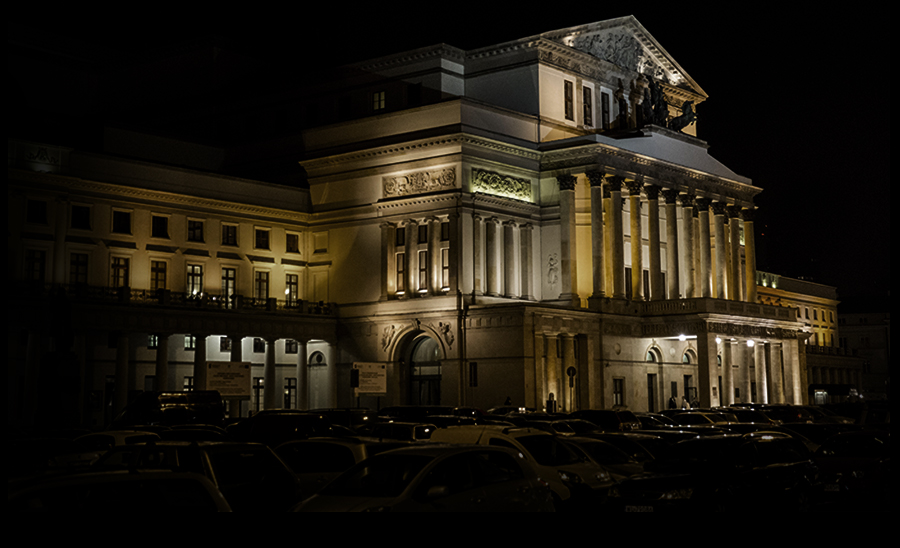
Teatr Wielki Opera Narodowa
Wiesław Ochman


Wiesław Ochman
  Since the times of Jan Kiepura, Wiesław Ochman was the first truly world-famous Polish tenor. What made this success even greater and more valuable was the fact that it is extremely hard for non-Italian artists to reach the vocal Olympus, especially tenors. It was a tough road involving a lot of hard work, taking a boy from Warsaw's Ząbkowska Street to the great stage of New York's Metropolitan Opera, and then also to Milan's La Scala – the greatest dream of any singer.

   It does need saying, though, that initially the young Ochman didn't dream of a singer's career at all. Born in Warsaw on 6 February 1937, he ardently wanted to be a painter, so after leaving primary school in Warsaw's Praga district, he enrolled at the Secondary School of Visual Arts in Bolków, Lower Silesia. Two years later, the school was moved to Szczawno-Zdrój and transformed into the Technical School of Ceramic Decoration, from which Ochman graduated with honours. He started studying at the Ceramics Department of the Academy of Mining and Metallurgy in Kraków. Encouraged by friends, he performed at an official ceremony, and that was when Prof. Gustaw Serafin, a valued singing teacher, heard him. His opinion led Ochman to commence vocal studies, and the prize he won a year later at a local vocal competition settled the matter once and for all.

   In 1960, Ochman received his M.Sc. engineering degree, but decided to take advantage of nature's gift - his unusually beautiful voice - and choose an artistic career: he joined the Silesian State Opera. For three seasons, he performed a number of major parts there, including Edgar in Lucia di Lammermoor, and continued his vocal training with Prof. Maria Szłapak. In the autumn of 1963, he transferred to the opera house in Kraków, but a year later returned to his home city of Warsaw, where the Teatr Wielki was about to be reopened after being rebuilt from rubble.

   The performance in Halka, prepared together with three other productions for the November 1965 grand opening of this temple of the arts in Warsaw, became the turning point in Wiesław Ochman's career. His magnificent creation of the part of Jontek won him the audience's enthusiasm and the highest praise from the critics, both Polish and foreign. In the same season, Ochman successfully sang the title part in Faust as well. This resulted in his being invited to Berlin by the famous State Opera, where he sang the part of Turiddu at the premiere of Cavalleria Rusticana in January 1967, and then to Munich (La Traviata at the Opera Festival) and Hamburg (Tosca in September 1967). The young singer's fame kept growing. Subsequent invitations came flooding in – he even had to turn some of them down. Soon, Wiesław Ochman scored his first successes at the exclusive festivals of Glyndebourne (Lensky in Onegin, then Tamino in The Magic Flute) and Salzburg, and – something unheard-of before – the Polish tenor gained international fame as an excellent interpreter of Mozart parts. In particular, he became an excellent and much sought-after performer of the part of Ottavio in Don Juan (reviewers noted their appreciation for his interesting stage approach to the part), and the title role in Idomeneo.

   In 1972, Ochman appeared at the Paris Opera. He also performed across the ocean – in Chicago and San Francisco. Works he recorded for Polskie Nagrania and for West Germany's Deutsche Grammophon included Idomeneo, Richard Strauss's Salome, Mozart's Requiem as well as Moniuszko's Halka and, a little later, The Haunted Manor. He played the main part in the television film The Tsarevich based on the operetta by Lehar. He received a State Award Second Class in 1973 for great achievement, and in 1976 – the City of Kraków Award and the Polish Radio Award. At the height of his fame, he continued to expand his repertoire, always remaining a model of intelligent diligence and conscientiousness to his colleagues. He gave vent to his former passion for painting by collecting outstanding works by Polish painters, turning his Warsaw home into a small art gallery. He has always valued the privacy of his home, and his family life.

   Among Wiesław Ochman's extensive repertoire, particularly interesting and important parts include Arrigo in Verdi's once-forgotten opera I Vespri Siciliani. Ochman sang it as early as 1969 in Hamburg, at the theatre with which he was working for a few seasons at the time, then in Paris, and in 1975 this part was his successful debut at the Metropolitan Opera in New York. At this famous theatre, he went on to perform the part of Lensky in Eugene Onegin, the False Dmitri in Boris Godunov (whom he also played in the famous Paris production by Joseph Losey) and, in 1985, Prince Golitsyn in Khovanshchina.

   Three years previously, in 1982, this was the part which also marked his operatic debut at Milan's La Scala, where he had already performed in Mozart's Mass in C Major conducted by Claudio Abbado. All this shows that apart from popular parts from the traditional repertoire, Wiesław Ochman also sang, especially in later years, a sizable number of unusual parts that few outstanding artists undertake. To the previously mentioned Idomeneo, Narraboth, Arrigo, Dmitri or Golitsyn, add Lace in Janaček's Jenufa (Geneva, West Berlin, San Francisco), Eric in Wagner's The Flying Dutchman (opera festival in Orange, West Berlin) and, in the spring of 1987, Herod in R. Strauss's Salome (Houston, United States).

   Performing at the greatest theatres of Europe and America, he never forgot his home country. Practically every season, he appeared at least once at Warsaw's Teatr Wielki – most often as Alfred or Cavaradossi, but we also remember his splendid creations in Lucia di Lammermoor and Cavalleria Rusticana.

   Oratorio music is a separate field of Ochman's artistic activity. The extreme breadth of this field – by our standards – is documented by numerous recordings. In fact, Wiesław Ochman has the largest number of recordings to his credit among all the Polish singers, both from the present and from earlier generations.


Photo: Archive